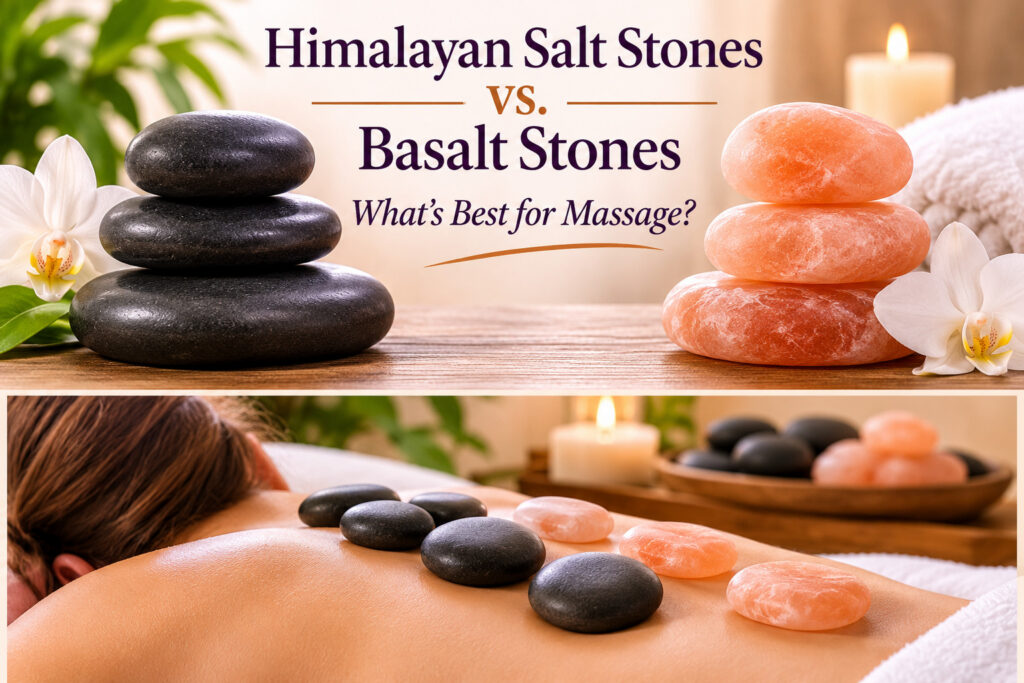
Himalayan Salt vs. Basalt Stones
Read More
Stone Massage, What's New, Pet Stone Massage, Health & Wellness, Sonia Alexandra

Himalayan Salt Stones vs. Traditional Basalt Stones: What’s New in the World of Stone Massage?

A Professional Massage Therapist’s Guide to Understanding the Differences

Stone massage has evolved considerably over the years. What began as a specialized spa treatment has become an established modality in the massage and wellness industry.

Today, massage therapists have more choices than ever when selecting stones for their practice. Among the newer options attracting attention are Himalayan salt stones, which are being introduced as an alternative to traditional basalt stones.

Which stones are better?

Neither, each has its distinct benefits.

Let’s take a closer look.

1. Traditional Basalt Stones: The Foundation of Hot Stone Massage

Basalt stones have long been the preferred choice for traditional hot stone massage.

Formed from cooled volcanic lava, basalt is a dense, fine-grained rock with excellent heat-retaining properties. Its smooth surface and ability to maintain warmth make it particularly well suited for professional massage applications.

Why massage therapists choose basalt:

  • Excellent heat retention.
  • Smooth surfaces that glide comfortably across the body.
  • Durable material suitable for repeated professional use.
  • Well suited to traditional hot stone massage techniques.
  • Compatible with established water-based stone heating systems.

Basalt stones are generally heated in a temperature-controlled water warmer. They can be used as massage tools or strategically placed on the body as part of a treatment.

For therapists who practice traditional hot stone massage, basalt remains an important and versatile tool.

2. Himalayan Salt Stones: A Newer Approach

Himalayan salt stones have introduced a different approach to the stone massage experience.

Typically recognizable by their beautiful pink, rose, and orange hues, these stones are made from natural rock salt. They offer a distinctive appearance and a different feel from traditional volcanic basalt.

Salt stones are often used with dry-heating systems rather than conventional water baths.

Why massage therapists are exploring salt stones:

  • Their distinctive appearance adds a different aesthetic to the treatment room.
  • They can provide gentle, soothing warmth.
  • Their smooth surfaces offer a different tactile experience.
  • Certain salt stone systems allow convenient dry heating.
  • They can be incorporated into relaxation-focused massage treatments.

Salt stones do require special care. Because salt is water-soluble and absorbs moisture, they should not be soaked or cleaned like traditional basalt stones. Proper drying, storage, and manufacturer-recommended maintenance are essential. They are more easily susceptible to breakage than basalt stones.

It is also important to understand that claims about mineral absorption through the skin or specific detoxification benefits should not be confused with established clinical evidence.

3. Comparing Salt Stones and Basalt Stones

FeatureTraditional BasaltHimalayan Salt
MaterialVolcanic rockNatural rock salt
AppearanceDark gray to blackPink, rose and orange
HeatingWater-based warmerOften dry-heating system
Heat applicationWarm massage and placementGenerally gentle warmth
DurabilityHighly durableRequires moisture-conscious care
CleaningWashing and appropriate disinfectionDry cleaning and compatible disinfection
MaintenanceRelatively straightforwardRequires special attention to moisture
Traditional useEstablished hot stone massageNewer alternative and complementary approach

Neither material should be considered universally better. The appropriate choice depends on the therapist’s technique, treatment goals, equipment, and training.

4. Does the Type of Stone Make a Difference to the Massage?

Absolutely. The stone is a tool, and the material influences how that tool is used.

Basalt’s density and heat-retaining characteristics make it particularly useful for traditional hot stone protocols, including massage strokes and carefully controlled stone placement.

Salt stones offer another sensory experience. Their appearance, surface characteristics, and heating requirements may appeal to therapists looking to expand their treatment offerings.

However, the stone itself does not replace the therapist’s knowledge of anatomy, temperature control, client assessment, and appropriate application.

The skill is in knowing how and when to use the stone.

5. Safety and Professional Considerations

Regardless of the stone selected, client safety must remain the priority.

Massage therapists should:

  • Use equipment specifically designed for heating the particular type of stone.
  • Monitor stone temperatures with appropriate instruments.
  • Test stones before applying them to clients.
  • Consider individual client sensitivity and medical conditions.
  • Avoid excessive heat and prolonged stationary placement.
  • Follow appropriate cleaning and disinfection procedures between clients.

An important distinction: although salt is often described as naturally antimicrobial, this does not eliminate the need for proper professional sanitation.

A safe treatment depends on sound procedures, not assumptions about the material.

6. So, Which Stone Should You Choose?

The answer depends on what you want to accomplish in your practice.

Choose traditional basalt when:

  • You want to practice established hot stone massage techniques.
  • Consistent warmth and heat retention are important.
  • You want a durable, versatile set of professional massage stones.
  • You are building your foundation in traditional stone massage.

Explore Himalayan salt stones when:

  • You want to introduce a different sensory experience.
  • You are interested in expanding your spa menu.
  • You want to explore dry-heated stone applications.
  • You are prepared to follow the specific maintenance requirements of salt stones.

Some therapists may find value in offering both, provided they understand the different equipment, handling, and application requirements.

7. The Bottom Line: Technology and Trends May Change, but Knowledge Matters

The introduction of Himalayan salt stones represents another interesting development in the world of massage therapy.

New products and techniques will continue to emerge. But choosing the right stone is only one part of providing an effective, professional treatment.

Understanding the properties of the stones, their proper application, temperature requirements, and the techniques behind stone massage is what separates simply using stones from practicing stone therapy.

At Stonehealing.com, we believe that education is the foundation of exceptional stone massage.

Whether you are new to stone massage or an experienced massage professional looking to expand your skills, learning the principles behind the modality is an investment in your professional development.

Discover Stone Massage Education and Continuing Education Opportunities at Stonehealing.com.

Explore our professional courses and take the next step in expanding your massage therapy skills.

Visit: https://www.stonehealing.com/
Himalayan Salt vs. Basalt Stones

stone massage
Read More
Business Growth, Continuing Massage Therapy Education, Stone Healing, What's New, Pet Stone Massage, Health & Wellness, Sonia Alexandra, News

How to Become Trained in Hot Stone Massage: A Guide for Massage Therapists

By Sonia Alexandra, Stone Massage Educator and Founder of Stone Healing

If you are a licensed massage therapist looking to expand your skills, attract new clients, and bring a different dimension to your treatments, learning hot stone massage may be a wonderful next step in your professional journey.

Over the years, I have seen how introducing stone massage can inspire therapists to approach their work with fresh eyes. The combination of skilled hands-on techniques, carefully selected stones, and therapeutic warmth creates an opportunity to expand the services you offer and the experiences you provide to your clients.

I am Sonia Alexandra, founder of Stone Healing, and I have devoted much of my professional life to developing, teaching, and sharing stone massage techniques. I would like to share what I believe every therapist should know before beginning this journey.

My Journey with Stone Massage

My personal journey with stone massage began in the late 1990s, when I was operating Avanti Day Spa in Hollywood, Florida.

I devoted approximately six months to working intensively with stones and massage, exploring how the stones could be integrated into professional massage treatments. I was fascinated by the possibilities and wanted to develop a structured approach that other massage therapists could learn and apply responsibly.

I contacted the State of Florida to obtain a list of massage therapists and began reaching out to professionals who might be interested in learning this new modality. The response was overwhelmingly positive.

That response encouraged me to continue developing educational materials and eventually offer resources online, making stone massage education accessible to therapists beyond my local community. Interest grew, reaching students and professionals internationally.

What began as a dedicated exploration of a new massage modality became a long-term commitment to education.

That is why I encourage massage therapists to approach stone massage as more than simply placing warm stones on the body. It is a professional skill that deserves thoughtful training, practice, and a solid understanding of safety.

Why Learn Hot Stone Massage?

Massage therapists are continually looking for ways to develop their skills and meet the changing interests of their clients.

Stone massage can complement a therapist’s existing practice when it is appropriate for the client and performed with proper training. It introduces additional techniques, equipment, stone placement methods, and considerations for managing heat safely.

Learning this modality can help you:

  • Expand the types of massage services you offer.
  • Develop confidence using warm and cool stones appropriately.
  • Add a new skill to your professional repertoire.
  • Explore additional educational opportunities as your experience grows.
  • Differentiate your services through thoughtful, well-executed treatments.

You do not need to abandon the massage techniques you already know. The goal is to learn how stone massage can complement your existing professional skills.

How to Become Trained in Hot Stone Massage

If you are ready to learn, I recommend following these steps.

1. Choose a structured training program

Look for a course specifically designed to teach stone massage to massage therapists. A collection of general instructions or a short demonstration may not provide the depth of education you need.

A well-structured course should explain the techniques, demonstrate their application, and provide opportunities to review the material and practice your skills.

Consider whether the course is suitable for your experience level and whether it provides a foundation before introducing more advanced methods.

2. Make safety a priority

Working with heated stones requires knowledge and attention. The stones must be heated using appropriate professional equipment, and their temperatures must be checked and managed carefully.

Your training should address proper sanitation, safe stone handling, client communication, appropriate placement, temperature monitoring, and situations in which heat or stone massage may be unsuitable.

Always follow professional training, equipment instructions, applicable practice requirements, and appropriate client-care procedures. Never assume that a stone is safe simply because it feels comfortable in your hand.

A therapist’s first responsibility is to provide care that is appropriate and safe for the individual client.

3. Learn stone selection and placement

Not all stones are interchangeable. A good training program should help you understand which stones are appropriate for the techniques being taught and how their size, shape, surface, and temperature affect their handling.

You should learn how to position and manipulate stones properly, how to incorporate them into massage movements, and how to work with them while maintaining appropriate client comfort and control.

The objective is not merely to learn a sequence. It is to understand the techniques well enough to apply them thoughtfully in your own practice.

4. Look for step-by-step demonstrations

Reading a manual can be valuable, but seeing a technique demonstrated adds another dimension to learning.

Choose a program that allows you to review the instructor’s methods and revisit individual steps as you practice. Structured learning materials, demonstrations, placement charts, and clear instructions can help you build confidence at your own pace.

Remember that watching a demonstration is only part of the process. Practice, careful attention to technique, and continued learning are essential.

5. Verify continuing education requirements

If you need continuing education credits for license renewal, check the course’s current approval details before enrolling.

Requirements can differ by state, licensing authority, and professional credential. Confirm that the particular course and provider meet the requirements applicable to you.

Also determine what documentation you will receive when you complete the program, including any examination or certificate requirements.

Can You Learn Hot Stone Massage Online?

Online and home-study education can be convenient for busy massage therapists, particularly those balancing clients, family responsibilities, and professional development.

The important question is not simply whether a course is online. It is whether the material is sufficiently detailed, practical, and clearly presented for the skills you need to learn.

Look for a course with a structured learning program, demonstrations, opportunities to review the techniques, and clear explanations of safety and application.

At Stone Healing, I developed educational programs to help massage therapists study at their own pace while building their knowledge of stone massage.

Our Stone Massage Level I course is offered as a self-paced e-course and currently lists 16 continuing education units. Its materials include a course workbook, a step-by-step demonstration, a stone placement chart, and a final examination. Please review the course page for current details and verify that its credits meet your particular requirements.

You can learn more here:

Explore Stone Massage Level I Training

What Comes After Your First Course?

Your initial training is the beginning, not the end, of your professional development.

Once you have established a solid foundation, you may wish to explore advanced stone massage techniques, facial stone massage, or other specialized applications that suit your interests and professional scope.

Continue practicing what you learn, refine your technique, and remain attentive to your clients’ responses. As with any massage modality, your professional judgment, communication, and commitment to safe practice matter just as much as the techniques themselves.

Select additional courses carefully, making sure they build on your experience and meet your professional objectives.

A Personal Word to Fellow Massage Therapists

I have always believed that education is one of the most valuable investments a massage therapist can make.

When I began exploring stone massage decades ago, I wanted to share what I was learning with fellow therapists. That desire to teach, encourage professional growth, and make educational opportunities more accessible remains central to my work.

If you are curious about hot stone massage, I encourage you to approach it with an open mind, a commitment to learning, and respect for the responsibility involved in working with clients.

Choose your training thoughtfully. Take the time to understand the techniques. Practice carefully. And remember that professional development is an ongoing journey.

My mission through Stone Healing is to help massage therapists continue learning, expand their skills, and discover new possibilities within their practices.

If you are ready to begin learning stone massage, I invite you to explore the educational programs available at Stone Healing.

Discover Stone Massage Courses at Stone Healing

With gratitude and respect,

Sonia Alexandra
Stone Massage Educator and Founder of Stone Healing
www.stonehealing.com

massage therapist heals at stonehealing.com
Read More
Business Growth, Continuing Massage Therapy Education, Stone Healing, Stone Massage, What's New, Health & Wellness, News

The New Wave: Emerging Massage Modalities and How AI Is Helping Therapists Learn, Get Certified, and Grow

Massage therapy has always sat at the crossroads of ancient wisdom and living, breathing practice. Long before “wellness” was a market category, healers were using heated stones, rhythmic pressure, and intentional touch to help the body find balance. That tradition hasn’t gone anywhere but the world around it and us has changed, and today’s therapists have more tools than ever to deepen their skills, build sustainable careers, and support one another as a community.

Two forces are reshaping the profession right now: 1) a new generation of modalities that blend clinical precision with age-old technique, and 2) a wave of AI tools that are quietly taking over the busywork, so therapists can spend more time doing what they love: working with clients. Here’s a look at both, and how they fit together.

The Modalities Shaping Massage Therapy Right Now

A few themes stand out among the techniques gaining ground with practitioners and clients alike:

  • Precision Neuromuscular Therapy (PNMT) — an assessment-driven, problem-solving approach that combines clinical reasoning with highly targeted hands-on work, rather than a one-size-fits-all routine.
  • Myofascial Release — sustained, gentle pressure on the fascial system to reduce tissue density and restore mobility in areas of chronic tension.
  • Manual Lymphatic Drainage (MLD) — a light-touch, rhythmic technique that supports the body’s fluid movement, increasingly used in post-surgical and recovery care.
  • Japanese-Rooted Techniques — shiatsu, zen shiatsu, and kobido are bringing clothed, pressure-point bodywork back into the spotlight as an alternative to oil-based table massage.
  • Craniosacral Therapy — an extremely gentle, low-force approach aimed at calming the nervous system rather than working the muscles directly.
  • Trauma-Informed Care — less a technique than a philosophy: clear communication, ongoing consent, and a session paced around the client’s sense of safety.
  • Sports Recovery Massage — goal-oriented bodywork focused on reducing injury risk and supporting active bodies, increasingly woven into training and rehab programs.

What ties all of these together is intention. Clients aren’t just looking to relax anymore — they want sessions that are personalized, evidence-informed, and responsive to what their bodies actually need. That’s very much in the spirit of hot stone therapy itself: it has always been more than a “hot rock on a sore back.” Done well, it’s a precise, intentional practice — reading the body, working with temperature and pressure together, and adapting to each individual client. It’s part of why we’ve built out certification paths like our Stone Massage Level I & II, Stone Facial Massage, and Zone Energy Therapy courses — to help therapists bring that same precision and intention to an ancient modality that’s very much still evolving.

Where AI Fits In — Without Replacing the Human Touch

Let’s be clear about something up front: no amount of technology replaces a skilled pair of hands, a trained eye, or the trust built between a therapist and a client. But AI has quietly become a genuinely useful assistant for the parts of the job that happen outside the treatment room, e.g. the learning, the paperwork, and the business side that so many therapists find themselves juggling alone.

Learning and skill-building. General-purpose AI assistants like ChatGPT and Claude can be surprisingly useful study partners. Therapists are using them to quiz themselves on anatomy and pathology before exams, get plain-language explanations of an unfamiliar technique or contraindication, or summarize a dense continuing-education article into the few key takeaways that matter for practice. They’re not a substitute for hands-on training or an accredited course — but as a study aid between class sessions, they can genuinely help people retain the material.

Certification and continuing education. Staying board-certified means tracking CE hours, renewal deadlines, and state-specific requirements — details that are easy to lose track of in a busy practice. AI-powered reminders and simple automation (even something as basic as an AI calendar assistant) can help make sure a renewal deadline never sneaks up on you. It’s a small thing, but it’s the kind of small thing that protects a career you’ve worked hard to build.

Growing the business. This is where AI tools are having the biggest visible impact for solo and small-studio therapists:

  • Marketing content — AI tools help therapists create professional-looking flyers, social posts, and promotional graphics without hiring a designer.
  • Scheduling — AI-assisted booking tools (Calendly and similar platforms) handle reminders, rescheduling, and reduce no-shows automatically.
  • Client communication — AI can help draft FAQ responses, follow-up messages, and newsletters, so client relationships stay warm even when your hands are full — literally.
  • Website content and SEO — AI writing assistants can help draft blog posts, articles, and other documents that explain your services and techniques to prospective and current clients searching online, helping the right people find their way.

The common thread: AI is best used to reclaim time, not to replace expertise. The therapists getting the most out of these tools are using them to clear away administrative noise so they have more energy — and more hours in the week — for the technique itself, for continuing their education, and for their clients.

Growing Together, as a Community

If there’s one thing this moment in massage therapy calls for, it’s togetherness. New modalities spread fastest when therapists share what’s working with each other. New technology gets used well when people compare notes instead of guessing alone. And a career in bodywork, physically demanding, deeply personal work, is a lot more sustainable when it doesn’t feel like you’re building it in isolation.

That’s the spirit behind everything we do here at StoneHealing.com: not just certifying therapists in a technique, but supporting the whole practitioner — their skill, their business, and their place in a community of people doing meaningful work. Whether you’re exploring your first Stone Massage certification, adding Zone Energy Therapy or Dog Stone Massage to your specialties, or simply looking for the continuing education you need to stay board-certified, we’d love to have you learning alongside us.

Take a look at our current courses and stone healing tools, and if you’re already a graduate, we’d genuinely love to hear how you’re blending new modalities (and new technology) into your own practice. This field grows stronger every time we share what we know.

Stone Massage, What's New, Health & Wellness, Sonia Alexandra

Learn Stone Massage From the Pioneer – Sonia Alexandra, LMT: Massage Industry Leader and Developer of the Stone Massage Technique

originator

Picture White Jacket1


Did You Know? Insurance companies now require Stone Massage Practitioners to be certified. Professionals should also be proficient in the application of specific aspects of the modality, such as the Fitzpatrick Scale.

Sonia Alexandra, L.M.T., is a trusted voice for thousands in the wellness industry, and is an internationally recognized expert in this field. She has created the leading Stone Massage manufacturing and educational company, a globally recognized firm with a worldwide distribution and education network. As the leading developer of and authority on the world-renowned Stone Massage Therapy concept, she has presented in countless countries and venues, including the International Congress of Esthetics and Spa.

Click on the Menu below to visit Stone-Healing.com

stone-healing_ad

Stone Massage, What's New

Mandatory Massage Certification for License Renewal


ATTENTION: Licensed Massage Therapists of Florida (Special Offer)

StoneMassage Level IILIMITED-TIME OFFER  – 24 Continuing Education (CE) Hours –  $125.00!!!
(Click Here to view this special offer)

NEW RULES REGARDING LICENSE RENEWAL

License Renewal Requirements have changed. By January of 2015 (only 6 months away), licensed massage therapists will no longer be able to renew their massage therapy licenses without completing continuing education.

Our industry is ever-evolving and it seems that recent trends have changed the marketplace, perhaps cutting into your profits. Continuing Education will always keep you at the forefront of the job market.

Stone Massage Certification – through Stone-Healing.com, will easily fill your requirements, as we are sanctioned by the State of Florida for this purpose. Stone Massage is an awesome modality to add to your skill set, thus increasing your profitability. Get started today towards your certification in Stone Massage through Stone-Healing.com.

LIMITED-TIME OFFER  – 24 Continuing Education (CE) Hours –  $125.00!!!

(Click Here to view this special offer)

By,

         Sonia Alexandra, LMT

Stone-Healing.com

Stone Healing on Facebook

Sonia Alexandra on LinkedIn

Stone Massage, What's New, Pet Stone Massage, Health & Wellness, Sonia Alexandra, Energy Healing

Origin of the Word “Massage”

Greetings Fellow Massage Therapists and Healing Enthusiasts,

The words we speak carry tremendous meaning, often more significant than we may even be aware of. Let us delve into the origin and meaning of the word “massage.”

 According to one Etymology dictionary, the English word massage is derived from the French word massage, meaning “friction or kneading.” The French may have borrowed the word massage from colonial India, where the Portuguese used the word amasser, or “to knead” from the Latin word massa, meaning “mass, dough.”  It also may derive from the Arabic word massa, meaning “to touch, feel, handle;”

Remember that you are a member of a select group of healers, who have been touching lives across the world since the beginning of civilization through the power of the healing touch. We are all connected.

 Sonia Alexandra, LMT

What's New

Presenting a Three-Part Series on Understanding Domestic Violence – Part 1

Presenting a Three-Part Series on Understanding Domestic Violence
Part 1

dm

A Massage Professional Can Be a Refuge, Offering a Safe Place

It’s Personal for the victim to let someone they trust see the bruises on their body and soul.

Every nine seconds, a woman is assaulted or beaten in the U.S. Domestic violence is the leading cause of injury for women worldwide. 1 in every 3 women has been physically abused or beaten, often by a member of her own family.

Why Do Women Stay? Why Doesn’t She Just Leave?

These are usually the first two questions asked by the outside world when they hear that a woman is in an abusive relationship or violent situation. However, there are so many complex dynamics and obstacles preventing them from leaving.

dm2

A Massage Professional Can Be a Refuge, Offering a Safe Place

“I would never let this happen to me”, we convince ourselves. I can speak to you from personal experience as a victim of child abuse into my teens and also as an adult young woman many years ago; It can happen to anyone.

As massage therapists, we are in a special position to be keenly aware of the unexplained bruises, body language, fear and sadness, which are just some of symptoms we may encounter. Each individual traumatic encounter will vary.

dm3

A Massage Professional Can Be a Refuge, Offering a Safe Place

Domestic violence is a pattern of behavior used to establish power and control over another person through fear and intimidation and many times includes the threat and use of violence.

Domestic violence includes physical, emotional, psychological as well as economic and sexual abuse. Abusers always use intimidation, verbal threats, isolation from family and friends and other behavior, such as stalking, to maintain power over their victims. It affects everyone regardless of race, age, income, social standing or sexual orientation.

What's New, Health & Wellness, Sonia Alexandra

Presenting a Three-Part Series on Understanding Domestic Violence – Part 2

Presenting a Three-Part Series on Understanding Domestic Violence
Part 2

Domestic Violence Awareness

domestic-violence

Domestic violence is the leading cause of injury to women aged 15 to 44, a fact that is startling. Domestic violence is more frequent than ever imagined and affects everyone in the family.

Studies estimate that 10 to 20 percent of children are at risk for exposure to domestic violence. In other words, between 3.3 and 10 million children witness some form of domestic violence, which leaves emotional scars that last a lifetime. These children are twice as likely to become abusers themselves, so the cycle of abuse continues from generation to generation. It must be stated that women and children are not the only victims of domestic violence as men also are victims of this inhumane act.

Let us end this madness! How can we end it? Education is the first and foremost important step towards wiping out domestic violence from our midst. Let’s do it for us all, for humanity.

Of course, domestic violence leaves the victims physically injured, such as crippled, disfigured, and suffering from hearing loss. Domestic violence victims often also lose or miss out on many things in life, such as the loss of peace of mind, friends, loved ones and belongings. There is also the unseen emotional damage, including emotional scars and the inability to trust. Domestic violence victims also suffer from many forms of fear, such as the fear of being alone at night and the fear for their lives.

Society has a tendency to blame the victim. However, no one deserves to be abused, no matter what the circumstances are. Statistics show that 75% of women who are murdered by their batterers are killed when they leave or after they leave the relationship. Stepping away is not always easy.

Together, we can make difference.

https://www.dreamstime.com/-image23709534

What's New

We Are Massage Therapists

Life is a Sum of Our ChoicesWe will tell you we are all about caring, hoping and making a difference in peoples lives. We will also tell you that most of us have experienced a strange phenomenon, and we can all recall when it began for the first time. I named it the healing touch miracle long ago. It occurs between client and practitioner who have formed an emotional bond,it enters the room calmly, a subtle energy form, a cool cloud, a higher intelligence form. I can only describe it as pure ether energy.

In my personal experience that energy solidifies and creates the molecular restructure to the needed area of the body to assist in the healing process. Using the stone tapping procedure in conjunction with the therapy seem to amplify this process, due I suspect to the change in the body’s electromagnetic field. How the process occurs I leave to our keen scientists and their brilliance. As a spiritually motivated therapist dedicated to stone healing I can only humbly share this with deep respect.

Please let us hear from you and your personal experiences.

Sonia Alexandra