
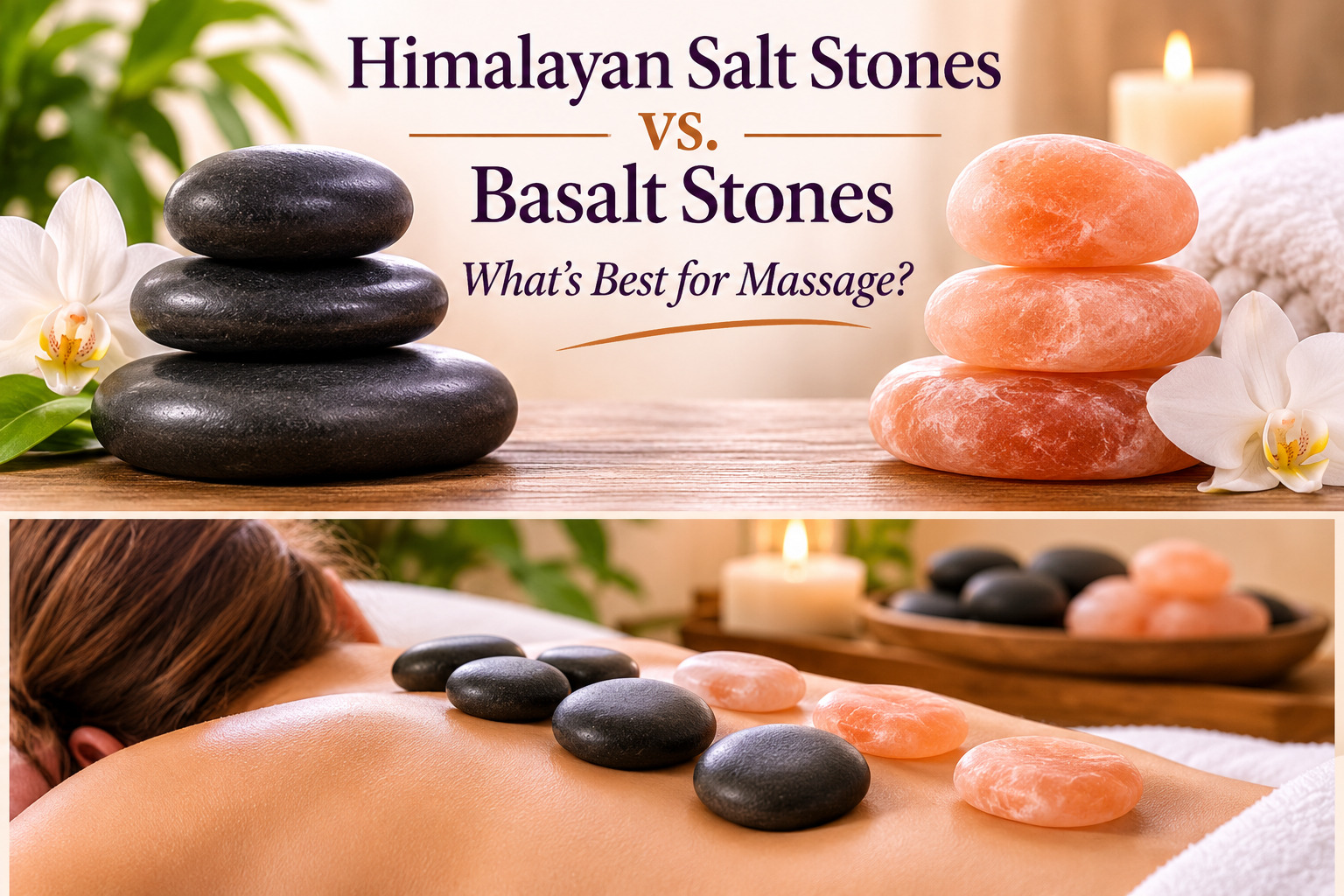
A Professional Massage Therapist’s Guide to Understanding the Differences
Stone massage has evolved considerably over the years. What began as a specialized spa treatment has become an established modality in the massage and wellness industry.
Today, massage therapists have more choices than ever when selecting stones for their practice. Among the newer options attracting attention are Himalayan salt stones, which are being introduced as an alternative to traditional basalt stones.
Which stones are better?
Neither, each has its distinct benefits.
Let’s take a closer look.
1. Traditional Basalt Stones: The Foundation of Hot Stone Massage
Basalt stones have long been the preferred choice for traditional hot stone massage.
Formed from cooled volcanic lava, basalt is a dense, fine-grained rock with excellent heat-retaining properties. Its smooth surface and ability to maintain warmth make it particularly well suited for professional massage applications.
Why massage therapists choose basalt:
- Excellent heat retention.
- Smooth surfaces that glide comfortably across the body.
- Durable material suitable for repeated professional use.
- Well suited to traditional hot stone massage techniques.
- Compatible with established water-based stone heating systems.
Basalt stones are generally heated in a temperature-controlled water warmer. They can be used as massage tools or strategically placed on the body as part of a treatment.
For therapists who practice traditional hot stone massage, basalt remains an important and versatile tool.
2. Himalayan Salt Stones: A Newer Approach
Himalayan salt stones have introduced a different approach to the stone massage experience.
Typically recognizable by their beautiful pink, rose, and orange hues, these stones are made from natural rock salt. They offer a distinctive appearance and a different feel from traditional volcanic basalt.
Salt stones are often used with dry-heating systems rather than conventional water baths.
Why massage therapists are exploring salt stones:
- Their distinctive appearance adds a different aesthetic to the treatment room.
- They can provide gentle, soothing warmth.
- Their smooth surfaces offer a different tactile experience.
- Certain salt stone systems allow convenient dry heating.
- They can be incorporated into relaxation-focused massage treatments.
Salt stones do require special care. Because salt is water-soluble and absorbs moisture, they should not be soaked or cleaned like traditional basalt stones. Proper drying, storage, and manufacturer-recommended maintenance are essential. They are more easily susceptible to breakage than basalt stones.
It is also important to understand that claims about mineral absorption through the skin or specific detoxification benefits should not be confused with established clinical evidence.
3. Comparing Salt Stones and Basalt Stones
| Feature | Traditional Basalt | Himalayan Salt |
|---|---|---|
| Material | Volcanic rock | Natural rock salt |
| Appearance | Dark gray to black | Pink, rose and orange |
| Heating | Water-based warmer | Often dry-heating system |
| Heat application | Warm massage and placement | Generally gentle warmth |
| Durability | Highly durable | Requires moisture-conscious care |
| Cleaning | Washing and appropriate disinfection | Dry cleaning and compatible disinfection |
| Maintenance | Relatively straightforward | Requires special attention to moisture |
| Traditional use | Established hot stone massage | Newer alternative and complementary approach |
Neither material should be considered universally better. The appropriate choice depends on the therapist’s technique, treatment goals, equipment, and training.
4. Does the Type of Stone Make a Difference to the Massage?
Absolutely. The stone is a tool, and the material influences how that tool is used.
Basalt’s density and heat-retaining characteristics make it particularly useful for traditional hot stone protocols, including massage strokes and carefully controlled stone placement.
Salt stones offer another sensory experience. Their appearance, surface characteristics, and heating requirements may appeal to therapists looking to expand their treatment offerings.
However, the stone itself does not replace the therapist’s knowledge of anatomy, temperature control, client assessment, and appropriate application.
The skill is in knowing how and when to use the stone.
5. Safety and Professional Considerations
Regardless of the stone selected, client safety must remain the priority.
Massage therapists should:
- Use equipment specifically designed for heating the particular type of stone.
- Monitor stone temperatures with appropriate instruments.
- Test stones before applying them to clients.
- Consider individual client sensitivity and medical conditions.
- Avoid excessive heat and prolonged stationary placement.
- Follow appropriate cleaning and disinfection procedures between clients.
An important distinction: although salt is often described as naturally antimicrobial, this does not eliminate the need for proper professional sanitation.
A safe treatment depends on sound procedures, not assumptions about the material.
6. So, Which Stone Should You Choose?
The answer depends on what you want to accomplish in your practice.
Choose traditional basalt when:
- You want to practice established hot stone massage techniques.
- Consistent warmth and heat retention are important.
- You want a durable, versatile set of professional massage stones.
- You are building your foundation in traditional stone massage.
Explore Himalayan salt stones when:
- You want to introduce a different sensory experience.
- You are interested in expanding your spa menu.
- You want to explore dry-heated stone applications.
- You are prepared to follow the specific maintenance requirements of salt stones.
Some therapists may find value in offering both, provided they understand the different equipment, handling, and application requirements.
7. The Bottom Line: Technology and Trends May Change, but Knowledge Matters
The introduction of Himalayan salt stones represents another interesting development in the world of massage therapy.
New products and techniques will continue to emerge. But choosing the right stone is only one part of providing an effective, professional treatment.
Understanding the properties of the stones, their proper application, temperature requirements, and the techniques behind stone massage is what separates simply using stones from practicing stone therapy.
At Stonehealing.com, we believe that education is the foundation of exceptional stone massage.
Whether you are new to stone massage or an experienced massage professional looking to expand your skills, learning the principles behind the modality is an investment in your professional development.
Discover Stone Massage Education and Continuing Education Opportunities at Stonehealing.com.
Explore our professional courses and take the next step in expanding your massage therapy skills.
Visit: https://www.stonehealing.com/


 Greetings my name is Sonia Alexandra, LMT and I am the founder of


 Monthly, there are thousands of new graduates all over the globe, and I would really like to give back to them through the educational capacity of